Changing how you use electricity
The forecast shows when would be the best times to use mains electricity. This is a guide to some of the ways you can use this forecast to reduce your everyday emissions.
- Change the time when you use electricity
- Use less
-
Always charge rechargeable batteries with low carbon electricity
Change the time when you use electricity
Perhaps the simplest, and maybe the easiest. Just use the forecast to plan the best time in the day to use items you reasonably have the flexibility to do so. These could be use of power tools, lawn mowers, power washers, washing machines, dryers, dishwashers and so on.
The variation in CO2 emissions can be as much as 40% during a typical day, so being selective on when you consume electricity can be very effective at reducing your overall emissions.
Use less electricity
Don't use appliances for longer than you really need to, and turn them off when you have finished with them.
There is a particular issue with most remote controlled devices, such as TVs, set-top boxes, wireless speaker systems, gaming consoles and so on in that they don't really turn off, but remain in a 'standby' mode which continues to
consume electricity. This is often a small price to pay for the convienience of remote control, but there are often long periods of the day and night when there is little chance of them being used, so they just sit there consuming
electricity unnecessarily.
The best thing is to get into the habit of turning them off properly when not being used, but it is both easy to forget and it can be inconvenient finding all the physical off switches. One solution to this is to group these items
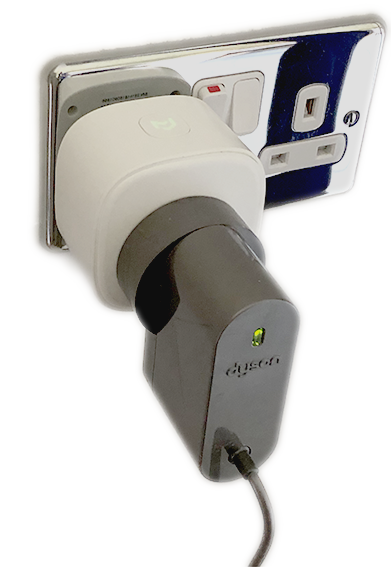
together onto a multi-socket strip and then use a smart plug to switch them all off in one go. The smart plug still consumes some power, but much less than all the other items do together. The advantage
of the smart plug of course is that it can be set up to work off schedules, so that all this switching is done automatically.
Take a look at suitable smart plugs
Rechargeable batteries
From cordless devices to electric cars, rechargeable batteries provide convenient energy storage and are seen as one of the key technologies to support reducing overall greenhouse gas emissions through greater electrification. Batteries allow you to decouple both where when you use mains electricity to charge them from when you use that electricity in the device, so ideally you would always charge when emissions were low.
However there are a couple of other important considerations with respect to recharegeable batteries though. Firstly, the both the charging and discharging cycles are not 100% efficient, with most systems only achieving around 85%
round trip efficiency. This means that the emissions associated with the energy you are using from the batteries is already over 15% worse than if you had used the electricity directly. Secondly, the manufacture of rechargeable
batteries themselves is highly energy intensive. Depending on the manufacturing source, much of the total emissions attributable to the device during its entire lifetime can come from its initial manufacture. As more of the world's
energy shifts to renewable sources, this will become less of an issue, but it is definitely still one today.
So, to minimise your CO2 emissions you should
- Consider whether or not you really need a device to be cordless. Their convenience really does come a cost to the environment.
- Minimise the amount of rechargeable batteries you have - don't get more battery capacity than you really need, and consider devices that can share a single battery.
- Make sure you charge any battery powered device with the lowest CO2 emissions electricity that you can. This is another great use for a smart plug.
Just for illustration, the CO2 emissions rate between midnight and 06:00 in the morning is on average 16% lower than for the remainder of the day (based on full-year data from 2019). So, whilst being more selective with charging timing would be more effective, just using a smart plug as a simple timer to only charge cordless devices overnight would still give useful savings.
Selected references and useful reading
Links to information relevant to the themes within this site
Article from Carbon Brief that shows that even though batteries have a high CO2 intensity of manufacture, for a typical electric vehicle this is more than offset during
its lifetime (May 2019): Factcheck: How electric vehicles help to tackle climate change
Paper that highlights the carbon intendity of current rechargeable battery manufacture (2017): The Life Cycle Energy Consumption and Greenhouse Gas Emissions from Lithium-Ion Batteries
Article from Carbon Brief that highlights the rise in renewables in the UK and also the effect that coronovirus has had on overall electricity demand (April 2020): Analysis: Great Britain hits coal-free electricity record amid coronavirus lockdown
Data on the UK’s electricity sector covering generation, fuel use, supply, consumption and power station capacity (March 2020): gov.uk